


Can You Jump a Car with an Electric Vehicle? What Every Driver Should Know
Picture this: you’re in a parking lot, and someone nearby has a dead battery. They look at your electric vehicle and wonder if you can help. It’s a question more drivers are asking as EVs become common on our roads. Can you jump a car with an electric vehicle? The short answer is yes, but there’s more to the story than a simple yes or no.
Electric vehicles work differently from traditional gas cars, and knowing the right approach keeps both vehicles safe. Whether you own an EV or you’re just curious about how these modern machines handle old-school problems, understanding the process matters. This guide walks you through everything you need to know about using your electric car to help a stranded motorist.
Key Takeaways
- Most electric vehicles can jump-start gas-powered cars, but always check your owner’s manual first.
- The 12-volt battery in an EV powers the jump, not the main battery pack.
- Some manufacturers explicitly warn against using their EVs as jump starters.
- Proper technique and safety precautions are essential to avoid damage.
- Portable jump starters offer a safer alternative for EV owners.
Free PDF Download, Can You Jump a Car with an Electric Vehicle?
jump_start_ev_guide_2pagesQuick Tip: Before You Connect Those Cables
Always inspect jumper cables before use. Look for cracks in the insulation, loose clamps, or corrosion on the clamps themselves. Poor quality or damaged cables increase the risk of sparks or poor connections. Keep a good set of heavy-gauge cables in your vehicle, preferably 4-gauge or thicker for reliable power transfer.
Check the dead battery for obvious problems before attempting a jump. A battery with visible damage, cracks, or leaking fluid shouldn’t be jumped. It needs replacement, not a boost. A swollen battery case indicates internal problems that make jump-starting dangerous.
Understanding How Electric Vehicles Handle Jump Starts
Electric vehicles might seem like they’re all about that massive battery pack under the floor, but they actually have two separate electrical systems. The high-voltage battery powers the motor and gets you down the road. Meanwhile, a standard 12-volt battery handles everyday tasks like powering your lights, radio, and computer systems. This smaller battery works similarly to what you’d find in any gas car.
When you jump a car with an electric vehicle, you’re using this 12-volt system. The setup looks familiar because it is. Your EV’s 12-volt battery connects to the dead battery through jumper cables, just like a traditional jump start. The main difference is what’s happening under the hood, or in this case, what’s not happening. There’s no combustion engine idling to keep things charged up.
Can You Jump a Gas Car with an Electric Vehicle?
Yes, you can jump a gas car with an electric vehicle in most cases. The process relies on that 12-volt auxiliary battery your EV carries. This battery exists specifically to run the car’s accessories and computer systems. It has enough juice to give another vehicle the boost it needs to start.
However, not every electric car manufacturer gives this practice the green light. Tesla, for example, warns against using their vehicles to jump-start others. The concern centers on potential damage to sensitive electronics. Other brands like Nissan and Chevrolet provide specific instructions for jump-starting with their EVs. Before you hook up those cables, spend two minutes checking what your manufacturer recommends. That quick check could save you from a $121 repair bill or worse.

The Technical Side: Why It Works (and When It Doesn’t)
The 12-volt battery in your electric vehicle gets recharged by a DC-to-DC converter that steps down power from the main battery pack. This system keeps the auxiliary battery topped up without you thinking about it. When you connect jumper cables, this 12-volt battery provides the electrical current needed to crank another car’s starter motor.
The challenge comes from how EVs manage their electrical systems. These vehicles have sophisticated battery management software that monitors every aspect of power flow. A sudden draw from jump-starting another car can trigger safety protocols or warning lights. Some systems might interpret the power drain as a fault and shut down protective circuits. This doesn’t mean jump-starting is impossible, just that your EV is more cautious about unexpected electrical events than a traditional car would be.
How to Jump a Car with an Electric Vehicle Safely
First things first: locate your EV’s 12-volt battery. In many electric vehicles, this battery hides under the hood or in the trunk area. Some models have specific jump-start terminals rather than direct battery access. Your owner’s manual shows exactly where to connect. Don’t skip this step and guess where things go.
Position your EV close enough to the dead car for the jumper cables to reach comfortably, but not so close that the vehicles touch. Turn off your electric vehicle completely. This matters more than with gas cars because you want to minimize any chance of electrical feedback into your systems. Make sure both cars are in park with parking brakes engaged.
Connect the cables in the right order: positive to positive first (red cable to the dead battery’s positive terminal, then to your EV’s positive terminal), then negative. Here’s where things differ slightly from traditional advice. Connect the negative cable to your EV’s negative terminal, but attach the other end to an unpainted metal surface on the dead car’s frame rather than directly to its negative terminal. This reduces spark risk near the battery.

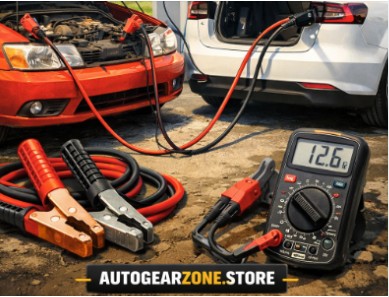
Can You Jump Start a Car from an Electric Car? Step by Step
Once your cables are connected properly, wait a moment. Give the dead battery a minute or two to accept some charge from your EV’s 12-volt system. This brief waiting period can make the difference between a successful jump and a failed attempt. The dead battery needs a little wake-up time.
Now have someone try starting the dead vehicle. If it cranks but doesn’t catch, wait another minute and try again. If the car starts successfully, let it run for a moment before disconnecting anything. When you’re ready to disconnect, reverse the connection order: remove the negative cable from the frame first, then from your EV, followed by the positive cables.
Keep your EV turned off during this entire process. Some drivers wonder if they should have their car “on” to provide more power, but this isn’t necessary and could actually cause problems. The 12-volt battery has enough capacity on its own. Once you’ve disconnected and stowed your cables, you might see a warning light on your EV’s dashboard. Don’t panic. Drive for a few miles to let the system recalibrate, and the light typically clears on its own.
Can an Electric Car Jump a Regular Car? Common Scenarios
The most common situation where you’d jump a gas powered car with an electric vehicle involves a neighbor, coworker, or family member with a dead battery. Standard passenger vehicles with dead batteries are perfect candidates for a jump from an EV. The power requirements match up well, and the process works smoothly.
Where things get trickier is with larger vehicles. Can you jump another car with an electric vehicle if that “car” is actually a truck or SUV with a bigger engine? Technically yes, but success depends on how dead the battery is and how much power the larger engine needs to turn over. A mildly dead battery in a truck should respond fine. A completely drained battery in a diesel truck might need more sustained power than your EV’s 12-volt system wants to provide safely.
Repeated jump-starting takes a toll. If you find yourself helping the same person jump their car multiple times, that’s a sign they need a new battery or have an electrical problem. Using your electric vehicle for occasional jumps is fine, but it shouldn’t become a regular thing. Each jump represents a significant draw on your 12-volt system, and frequent jumps could wear it down prematurely.
Can U Jump a Car with an Electric Car? Manufacturer Guidelines
Tesla explicitly tells owners not to use their vehicles for jump-starting. Their owner’s manual states this clearly. If you have a Tesla and someone asks for a jump, politely explain that your manufacturer recommends against it. Offer to call roadside assistance for them instead.
Nissan Leaf owners have better news. Nissan provides specific jump-start procedures in their documentation. The Leaf can jump-start another vehicle if you follow their guidelines carefully. They recommend using the jump-start terminal posts under the hood rather than the battery itself. This routing protects sensitive components.
Chevrolet Bolt owners can also help stranded motorists. GM includes jump-start instructions in the Bolt’s manual, complete with diagrams showing proper cable placement. They emphasize the importance of connecting to the right terminals and following the specified sequence. Ford’s electric vehicles similarly come with jump-start guidance, though they remind owners that the 12-volt battery has limited capacity compared to a running gas engine.
Can You Jump Start an Electric Vehicle Itself?
Now let’s flip the question. What happens when your electric vehicle’s 12-volt battery dies? Can someone jump start an electric vehicle the same way they’d help a gas car? The answer is yes, with some important details to understand.
Your EV’s 12-volt battery can die just like any other car battery. Cold weather, leaving lights on, or simple age can drain it. When this happens, you can’t access your car’s high-voltage system because the 12-volt battery controls those access points. You’re effectively locked out of your own vehicle’s power.
Getting a jump for your EV works almost identically to jumping a gas car. Another vehicle connects their positive and negative terminals to yours, provides a boost, and your systems come back online. The difference is what happens next. Once your 12-volt system has power, your EV’s DC-to-DC converter kicks in and starts recharging the small battery from the main pack. You don’t need to “drive around for 20 minutes” like you would with a gas car. Your EV handles the recharging internally.

The Risks: What Could Go Wrong
Electrical system damage tops the list of concerns when you jump a car with an electric vehicle. Modern EVs pack their engine compartments with sensitive electronics. A voltage spike during jump-starting could theoretically damage components. This risk is why manufacturers like Tesla simply say “don’t do it” rather than provide instructions.
Your 12-volt battery could drain faster than you expect. Unlike a gas car where the alternator constantly replenishes the battery while idling, your parked EV relies on stored charge in that 12-volt battery. If the dead car needs multiple attempts to start, you might drain your own battery to the point where it can’t perform its normal duties.
Incorrect cable connection causes the most immediate problems. Cross the positive and negative terminals, and you risk serious electrical damage to both vehicles. With an EV’s complex electronics, this mistake could be more expensive than with a traditional car. Take your time, double-check connections, and if you’re not confident, don’t attempt the jump.
Can I Jump Start from an Electric Car? Better Alternatives
Portable jump starters have become remarkably good and affordable. These compact battery packs specifically designed for jump-starting cars eliminate the need to connect vehicles at all. For EV owners concerned about protecting their vehicle’s systems, spending around $80 on a quality portable jumper makes sense. You can help others without any risk to your car.
These devices are small enough to keep in your trunk and hold their charge for months. When someone needs help, you hand them the portable jumper, they connect it to their battery, and their car starts. Your EV never enters the equation. This approach also helps if you’re the one stranded, since you can’t exactly jump yourself with your own car.
Roadside assistance programs provide another layer of security. AAA, your car insurance, or your EV manufacturer might include jump-start service. When you or someone else needs help, a professional arrives with proper equipment and knowledge. They carry heavy-duty jumpers and understand the nuances of different vehicle types.
Real-World Experiences: What EV Owners Report
Talk to EV owners who’ve jumped other cars, and you’ll hear mixed experiences. Many report successful jumps with no issues whatsoever. Their cars showed no warning lights, no system errors, and no lasting effects. These positive experiences typically involve newer EVs with robust electrical systems and drivers who followed proper procedures.
Some owners report warning lights appearing after jump-starting another vehicle. The most common is a “12-volt battery” warning that appears immediately after the jump. In most cases, these warnings clear after driving a short distance as the system recalibrates. Less commonly, owners have needed to visit a dealer to reset the warning.
A few owners have experienced actual problems. These typically involve either improper cable connection or attempting to jump a vehicle with a severely dead battery that drew too much power for too long. One Bolt owner reported needing to replace their 12-volt battery earlier than expected after regularly using their car to help a neighbor with chronic battery problems.
Table: Electric Vehicle Jump-Start Compatibility
| EV Model | Can Provide Jump | Manufacturer Guidance | Special Notes |
|---|---|---|---|
| Tesla Model 3/Y/S/X | Not Recommended | Manual says no | Use portable jumper instead |
| Nissan Leaf | Yes | Instructions provided | Use terminal posts under hood |
| Chevy Bolt/Bolt EUV | Yes | Instructions provided | Follow sequence carefully |
| Ford Mustang Mach-E | Yes | Instructions provided | 12V battery in frunk |
| Hyundai Ioniq 5 | Yes | Check manual first | Battery location varies |
| Volkswagen ID.4 | Yes | Instructions provided | Use designated terminals |
| Rivian R1T/R1S | Yes | Instructions provided | Access via front compartment |
| BMW i4/iX | Conditional | Specific procedures | Complex electrical system |
Expert Tip: Protecting Your Investment
Consider your electric vehicle an expensive piece of technology first and a jump-start donor second. If you’re uncertain about any aspect of the process, err on the side of caution. The goodwill you’d generate by helping someone doesn’t outweigh the potential cost of damaging your vehicle’s electrical system.
Keep your EV’s 12-volt battery maintained. This often-overlooked component needs attention just like the one in a gas car. Most EVs alert you if the 12-volt battery is getting weak, but don’t ignore these warnings. A healthy 12-volt battery makes your car more reliable and better able to handle the stress of jump-starting another vehicle if you choose to do so.
Document any jump-starts you provide. Note the date, the vehicle you helped, and any warning lights that appeared afterward. This record could be valuable if you later experience electrical issues and need to explain to your dealer or warranty provider what might have caused them.
The Legal and Warranty Considerations
Most EV warranties don’t specifically exclude coverage for damage caused by jump-starting another vehicle, but they don’t explicitly cover it either. Warranty language typically focuses on defects in materials or workmanship, not damage from use. If you jump someone’s car and something goes wrong with your EV, proving the two events are unrelated could be challenging.
Good Samaritan laws generally protect people who provide reasonable assistance in emergencies, including jump-starting cars. However, these laws typically apply to preventing liability for the person you’re helping, not necessarily protecting you from damage to your own property. If helping someone jump their car damages your EV, the law probably won’t help you recover costs from them.
Insurance implications are murky. Your auto insurance covers damage from accidents, vandalism, and weather, but would it cover electrical damage from voluntarily jump-starting another car? Probably not, since you’d be hard-pressed to call it an “accident.” Check with your insurer if you frequently help others with jumps and want to understand your coverage.
Environmental and Practical Considerations
Interestingly, electric vehicles that help gas cars get started contribute indirectly to reducing emissions. A stranded car waiting for help might need a tow truck to respond, which uses fuel. If you can get that car started quickly with a jump, you’ve avoided that fuel consumption. It’s a small environmental win.
The practical reality is that roadside emergencies don’t always happen at convenient times or places. Having the capability to help yourself or others adds value to your EV ownership experience. Whether you choose to actually provide jumps depends on your comfort level and your specific vehicle’s manufacturer guidance.
Cold weather complicates everything about batteries, including jump-starting. If you’re attempting to jump a car in freezing temperatures, both batteries are already working at reduced capacity. The dead battery might need more power to start the car, while your EV’s 12-volt battery can provide less. Success rates drop, and the risk of draining your own battery increases.
Frequently Asked Questions
Is it safe to jump start a car with an electric vehicle in the rain?
No, avoid jump-starting in wet conditions if possible. Water and electricity make a dangerous combination. If you absolutely must help someone in the rain, take extra precautions. Make sure everyone stays clear of puddles, the cable connections are as dry as possible, and work quickly to minimize exposure time. Consider waiting for the rain to stop or suggesting professional help instead.
How long should I wait after jump-starting another car before driving my EV?
You can drive immediately after disconnecting the jumper cables. Your EV’s DC-to-DC converter will start recharging the 12-volt battery automatically as soon as you power on. In fact, driving helps the system recalibrate faster if any warning lights appeared. Just drive normally and the car takes care of the rest.
Will jump-starting another car drain my EV’s main battery pack?
Not directly. The jump uses only your 12-volt auxiliary battery, not the high-voltage pack. However, after the jump, your DC-to-DC converter will draw from the main pack to recharge the 12-volt battery. This drain is minimal, usually less than what you’d use driving a single mile. You won’t notice any meaningful reduction in your driving range.
Can I use my EV to jump-start a hybrid vehicle?
Yes, hybrids have 12-volt batteries just like regular gas cars. The jump-start process is identical. Connect to the hybrid’s 12-volt battery or designated jump terminals, not its high-voltage system. The hybrid’s manual should specify where to connect. Treat it exactly like jumping a gas car, and you’ll be fine.
What should I do if my EV shows a warning light after providing a jump?
First, don’t panic. Drive the car for five to ten minutes at normal speeds. Many warning lights clear automatically as the system recalibrates. If the light persists after driving, check your owner’s manual to identify what it means. Most 12-volt battery warnings aren’t urgent. If the light stays on after a day or keeps returning, schedule a service appointment to have it checked.
When Not to Attempt a Jump Start
Some situations call for professional help rather than a DIY jump. If the dead vehicle is a large diesel truck, the power requirements might exceed what your EV’s 12-volt system can safely provide. Diesel engines need significant cranking power, especially in cold weather. Let someone with a gas-powered truck help or call for professional service.
If you’re at all uncertain about your EV’s capabilities or the proper procedure, don’t attempt the jump. Modern vehicles are expensive, and mistakes can be costly. There’s no shame in admitting you’re not comfortable with the process. Offering to call roadside assistance for someone provides help without risk.
Visibility matters too. If you’re on a busy road or in a dangerous location, prioritizing everyone’s safety over helping someone start their car makes sense. A jump-start isn’t worth getting hit by traffic. Wait for a tow truck or help relocating to a safer spot before attempting any roadside repairs.
The Future of Jump-Starting with EVs
As electric vehicles become more common, we’ll likely see better solutions for these situations. Some manufacturers might integrate jump-start capabilities more explicitly into their systems with protective measures that prevent damage. Others might move away from 12-volt batteries entirely, using the main battery pack more directly for all electrical needs.
Portable battery technology continues improving rapidly. The jump starters available today are smaller, more powerful, and more reliable than those from just five years ago. As this trend continues, the question of whether to jump a car with an electric vehicle might become moot. Everyone will carry a compact jumper in their trunk, and vehicle-to-vehicle jumping will become obsolete.
Vehicle-to-vehicle charging technology (V2V) is also developing. This would allow EVs to share high-voltage power with each other, effectively jump-starting a dead EV’s main battery pack. While this doesn’t help gas cars, it addresses a growing need as EV adoption increases. We might see this technology trickle down to assist gas cars in the future.
Making Your Decision: To Jump or Not to Jump
The choice to jump a car with an electric vehicle ultimately comes down to weighing risks against benefits. If your manufacturer provides clear instructions and you’re comfortable following them, helping someone makes you a good neighbor. If your manufacturer warns against it or you feel uncertain, declining is perfectly reasonable.
Consider keeping a portable jump starter in your EV as a compromise. You maintain the ability to help others without putting your vehicle at risk. These devices cost less than a single service call to deal with damaged electronics, making them a smart investment for any vehicle owner, gas or electric.
Your decision might also depend on the relationship with the person needing help. Jumping your spouse’s car when their battery dies feels different than helping a stranger in a parking lot. Both are kind gestures, but you might have different risk tolerances depending on the situation. Trust your instincts and make the choice that feels right for your circumstances.
Final Thoughts on Electric Vehicles and Jump-Starting
The question of whether you can jump a car with an electric vehicle has a nuanced answer that depends on your specific vehicle and situation. Most EVs can safely provide a jump to a gas-powered car if you follow proper procedures and your manufacturer approves. The 12-volt battery in your EV serves this purpose well, though it comes with some added considerations compared to a traditional car.
Smart preparation makes all the difference. Know your vehicle’s capabilities before you’re in a situation where someone needs help. Read your owner’s manual, understand where your 12-volt battery lives, and decide in advance whether you’re comfortable providing jumps. Consider investing in a portable jump starter to give yourself options without risk.
The automotive landscape continues evolving rapidly, and questions that seem straightforward often have complex answers. Jump-starting represents just one of many areas where electric and gas vehicles interact in unexpected ways. As you navigate EV ownership, staying informed about these details helps you make confident decisions that protect your investment while still being a helpful member of your community. Whether you choose to provide jumps with your electric vehicle or stick with alternative methods, understanding the full picture means you’re prepared for whatever the road brings.