


What Are The 5 Types of Electric Vehicles? Your Complete Guide to Choosing the Right EV
The automotive landscape has transformed dramatically. Walk into any dealership today and you’ll encounter a maze of unfamiliar terms—BEV, PHEV, HEV, MHEV, FCEV. For many shoppers, the question isn’t just “Should I go electric?” but rather “What are the 5 types of electric vehicles and which one makes sense for me?”
This comprehensive guide breaks down what are the 5 types of electric vehicles in plain language, helping you understand not only how these technologies work but also which one aligns with your daily driving needs, budget, and lifestyle.
What You Need to Know Right Away
Range concerns are largely outdated. Modern battery technology has evolved significantly, with many electric vehicles now offering 300+ miles per charge—more than enough for typical weekly driving.
“Electric” means different things. Some vehicles run purely on battery power, while others cleverly blend electric motors with traditional engines to deliver efficiency without range limitations.
Your charging situation matters most. Access to home charging fundamentally changes which EV type makes the most sense. No garage outlet? Some options actually work better for you.
The transition is more affordable than you think. Between improving technology, competitive pricing, and various incentive programs, electric mobility is increasingly accessible across different budget levels.


Breaking Down “Electric Vehicle”
When someone mentions an electric vehicle, what exactly does that mean?
At its core, an electric vehicle uses an electric motor not just a gasoline engine to drive the wheels. This motor draws power from a battery rather than burning fuel in real-time. But here’s where it gets interesting: when people ask “what are the 5 types of electric vehicles,” they’re really asking about the degree of electrification, which varies dramatically.
Some vehicles eliminate gasoline entirely, running on pure electricity. Others use electricity to supplement a traditional engine, creating a hybrid system. Still others generate electricity onboard using alternative fuels like hydrogen.
Understanding what are the 5 types of electric vehicles is essential because each approach comes with distinct trade-offs in terms of charging requirements, operating costs, and environmental impact.
What Are The 5 Types of Electric Vehicles? Breaking Down Each Category
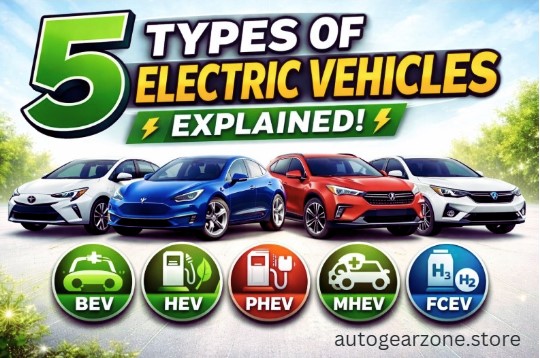
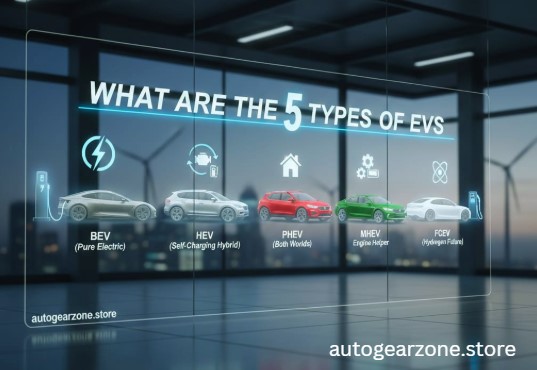
1- Battery Electric Vehicles (BEV): All-Electric, Zero Compromise
Think Tesla Model 3, Hyundai Ioniq 6, or Chevrolet Bolt. These are the pure electric vehicles no gasoline engine, no tailpipe, no fuel tank whatsoever.
A substantial battery pack stores electrical energy that powers one or more electric motors. These vehicles deliver immediate acceleration (electric motors produce maximum torque instantly) and whisper-quiet operation. Modern BEVs routinely achieve 250-350 miles of range, with some premium models exceeding 400 miles.
Best for: Daily commuters with home charging access who want to eliminate gas station visits entirely and minimize maintenance.
Key benefits:
- Completely emission-free operation
- Significantly lower maintenance requirements (no oil changes, fewer brake replacements due to regenerative braking)
- Potential for home charging convenience wake up to a “full tank” every morning
Considerations: Requires planning for longer trips around charging infrastructure, though fast-charging networks continue expanding rapidly.

2- Hybrid Electric Vehicles (HEV): Self-Sufficient Efficiency
The Toyota Prius pioneered this category and remains its most recognizable example. HEVs combine a gasoline engine with an electric motor and battery, but never plug in.
How do they charge? Through regenerative braking (capturing energy normally lost when slowing down) and the gasoline engine itself. The electric motor handles low-speed driving and assists during acceleration, while the gas engine takes over at highway speeds.
Best for: Urban drivers, those without charging access, or anyone wanting better fuel economy without changing their refueling habits.
Key benefits:
- No charging infrastructure needed
- Substantially better fuel economy than conventional vehicles (often 40-50+ mpg)
- Smoother, quieter driving in city conditions
Considerations: Still produces emissions, though significantly less than traditional vehicles. Can’t drive on electricity alone for extended distances.
3- Plug-In Hybrid Electric Vehicles (PHEV): Maximum Flexibility
PHEVs represent a middle ground, offering 25-50 miles of all-electric driving before switching to hybrid operation. They feature both a charging port and a fuel tank.
For many drivers, this electric-only range covers daily commuting entirely. Longer trips simply use the gasoline engine, eliminating range anxiety while still providing substantial electric driving.
Best for: Drivers who want electric operation for daily use but need gasoline backup for occasional long trips. Ideal for those transitioning from conventional vehicles.
Key benefits:
- Daily errands can be completed on electricity alone
- No range anxiety gasoline engine provides unlimited range
- Qualifies for various electric vehicle incentives in many regions
Considerations: More complex than either pure electric or conventional vehicles. Requires discipline to plug in regularly for maximum benefit.

4- Mild Hybrid Electric Vehicles (MHEV): Enhanced Conventional Vehicles
MHEVs represent the minimal level of electrification. A small battery and electric motor assist the gasoline engine but cannot power the vehicle independently.
This system enables smoother engine start-stop operation in traffic, provides modest acceleration assistance, and improves fuel economy by 10-20%. Think of it as a conventional vehicle with electric assistance rather than a true electric vehicle.
Best for: Drivers seeking improved efficiency and refinement without changing their driving or refueling habits, often at minimal additional cost.
Key benefits:
- Improved fuel economy over conventional engines
- Smoother driving experience
- No behavioral changes required
Considerations: Cannot drive on electricity alone. Smallest environmental benefit among electrified options.
5- Fuel Cell Electric Vehicles (FCEV): The Hydrogen Alternative
FCEVs generate electricity onboard using hydrogen fuel cells, producing only water vapor as emission. They refuel in minutes, similar to gasoline vehicles, and typically offer 300+ miles of range.
The challenge? Hydrogen refueling infrastructure remains extremely limited, currently concentrated in California, Japan, and parts of Europe. These vehicles represent promising technology that’s not yet practical for most drivers.
Best for: Early adopters in areas with hydrogen infrastructure, or commercial fleet applications.
Key benefits:
- Zero emissions (water vapor only)
- Quick refueling times
- Long range comparable to gasoline vehicles
Considerations: Severely limited refueling infrastructure. Higher vehicle costs. Uncertain infrastructure expansion timeline.
Comparing What Are The 5 Types of Electric Vehicles: Side-by-Side
| Vehicle Type | Charges via Plug | Main Energy Source | Emissions Level | Driving Range |
|---|---|---|---|---|
| BEV | Yes | Battery electricity | Zero | 250-400+ miles |
| HEV | No | Gasoline + regenerative braking | Low | 500-700 miles |
| PHEV | Yes | Battery + gasoline | Low to moderate | 25-50 electric, 400+ total |
| MHEV | No | Gasoline with electric assist | Moderate | 400-600 miles |
| FCEV | No (hydrogen) | Hydrogen fuel cell | Zero | 300-400 miles |
Leading Manufacturers by Category
Tesla continues dominating the BEV market with Model 3, Model Y, and expanding lineup, though competition intensifies from traditional automakers.
Toyota remains the hybrid leader with decades of HEV experience, while also investing heavily in hydrogen fuel cell technology.
Hyundai and Kia have emerged as strong BEV and PHEV competitors, offering competitive pricing and advanced fast-charging capabilities.
Ford and Rivian are transforming the pickup and SUV segments with electric options, addressing a previously underserved market.
BMW and Mercedes-Benz focus on premium MHEVs and PHEVs, bringing electrification to luxury segments.
Making Your Decision: Choosing From What Are The 5 Types of Electric Vehicles
Now that you understand what are the 5 types of electric vehicles, choosing between these options ultimately depends on three factors:
Your daily driving patterns. Short, predictable commutes favor BEVs. Variable or long-distance driving may benefit from hybrid flexibility.
Your charging access. Home charging makes BEVs and PHEVs significantly more convenient. No home charging? HEVs offer electrification benefits without infrastructure dependence.
Your environmental goals versus practical needs. BEVs deliver maximum environmental benefit but require charging infrastructure. Hybrids reduce emissions substantially while maintaining conventional vehicle convenience.
Common Questions About What Are The 5 Types of Electric Vehicles
What’s the practical difference between EV and BEV? “EV” broadly describes any vehicle with an electric motor, while “BEV” specifically means a vehicle powered exclusively by battery electricity with no gasoline engine.
Which type costs least to maintain long-term? BEVs typically have the lowest maintenance costs due to fewer moving parts—no oil changes, simpler drivetrains, and less brake wear.
Do I need special training or licensing? No. All electric vehicle types are driven with standard driver’s licenses and require no special training.
How long do batteries actually last? Modern EV batteries are designed to retain 70-80% capacity after 150,000+ miles, often outlasting the vehicles themselves. Most manufacturers warranty batteries for 8-10 years or 100,000 miles.
Does temperature affect electric range? Yes, extreme cold or heat reduces range somewhat, typically 10-30% in severe conditions. Modern vehicles include thermal management systems that minimize these effects.
Can I charge a PHEV from a regular outlet? Yes, most PHEVs can fully charge overnight using a standard 120V household outlet, though a 240V outlet charges faster.
The Bottom Line: Understanding What Are The 5 Types of Electric Vehicles
When you fully understand what are the 5 types of electric vehicles, the landscape offers genuine options for different lifestyles and priorities. There’s no single “best” choice only the best choice for your specific situation.
Start by honestly assessing your daily driving needs, charging access, and budget. The technology has matured to the point where there’s likely an electric or electrified option that fits your life better than you might expect.
The transition to electric mobility is accelerating, and knowing what are the 5 types of electric vehicles positions you to make informed decisions that save money, reduce environmental impact, and embrace the future of transportation on your own terms.