



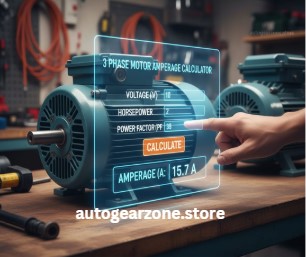
3 Phase Motor Amperage Calculator
The 3 Phase Motor Amperage Calculator helps you quickly estimate the running current of a three phase electric motor using standard electrical inputs. This tool is designed for engineers, technicians, electricians, and automation professionals who need fast and accurate current calculations without manual formulas.
By entering motor power, voltage, power factor, and efficiency, you can instantly determine the approximate line current. This makes it easier to select cables, circuit breakers, contactors, and protection devices with confidence.
Quick Tip
For fast estimates, use default values like 400V voltage, 0.8 power factor, and 90 percent efficiency. This gives a realistic current value for most industrial motors.
Key Points
- The 3 Phase Motor Amperage Calculator estimates motor current using voltage, power, power factor, and efficiency.
- It supports both kW and HP ratings, making it suitable for most industrial and automation motors.
- The calculated amperage helps with proper cable sizing, breaker selection, and motor protection planning.
Key Takeaways
- Accurate current calculation reduces the risk of overheating, voltage drop, and electrical failures.
- Always allow extra margin for starting current and real-world operating conditions.
- Using a calculator is faster and more reliable than manual calculations, especially when motor nameplate data is missing or unclear.
How the 3 Phase Motor Amperage Calculator Works
This calculator uses motor input power along with real world operating parameters. It supports both kW and HP values, making it suitable for industrial motors used in manufacturing, HVAC, pumps, compressors, and automation systems.
The result represents estimated full load current under normal operating conditions. Actual current may vary slightly depending on load type, motor design, and supply quality.
How to Use the Calculator
To calculate motor amperage, enter:
- Motor Voltage (commonly 208V, 230V, 400V, 415V, or 480V)
- Motor Power in kW or HP
- Power Factor, typically between 0.8 and 0.95
- Motor Efficiency, usually 75% to 95%
Once entered, the calculator instantly shows the estimated full load current. This value is suitable for general siz
When to Use This Calculator
Use this 3 Phase Motor Amperage Calculator when planning motor installations, upgrading control panels, or verifying electrical load requirements. It is especially useful during system design, maintenance checks, and safety evaluations.
This tool saves time, reduces calculation errors, and helps ensure proper electrical sizing for reliable motor operation.

How Motor Current Is Calculated
For three phase motors using line-to-line voltage, current is calculated using power, voltage, power factor, and efficiency. If power is given in horsepower, it is converted to watts using:
1 HP = 746 watts
The calculator handles these conversions automatically to reduce errors and save time.
Frequently Asked Questions
1. What is a 3 phase motor amperage calculator?
A 3 phase motor amperage calculator is a tool used to estimate the line current drawn by a three phase electric motor based on power, voltage, power factor, and efficiency.
2. Can I use this calculator for both kW and HP motors?
Yes. The calculator supports motors rated in kilowatts (kW) and horsepower (HP), making it suitable for both IEC and standard industrial motors.
3. Does this calculator give exact motor current?
The result is an estimated full load current. Actual current may vary depending on load conditions, motor type, and supply voltage variations.
4. What voltage values can I use?
You can use common three phase voltages such as 380V, 400V, 415V, 440V, or any custom industrial voltage.
5. Why are power factor and efficiency important?
Power factor and efficiency significantly affect current draw. Ignoring them can lead to undersized cables or incorrect breaker selection.
Common Questions and Answers
Q1: Can this calculator be used for star and delta motors?
Yes. The calculator estimates line current and works for both star and delta connected motors.
Q2: Is this suitable for VFD driven motors?
It provides a base estimate. For VFD systems, current may vary depending on speed and load profile.
Q3: What is a typical power factor for motors?
Most industrial motors operate between 0.75 and 0.9 power factor.
Q4: What efficiency should I enter if unknown?
If efficiency is not available, a safe average value is 90 percent for modern motors.
Q5: Can I use this for generator load calculation?
Yes, it can help estimate motor current when sizing generators or transformers.
Expert Tip
Always size cables, breakers, and contactors at least 20 to 25 percent above the calculated motor current to handle starting current, load variations, and long-term reliability