

Gas vs Electric Car Savings Calculator : Real Cost Per Mile Explained for Smart Drivers
|
Getting your Trinity Audio player ready...
|
Gas vs Electric Car Savings Calculator: Real Cost Per Mile Explained for Smart Drivers
Choosing between a gas car and an electric car goes beyond just picking an engine type. For most drivers in 2026, the decision comes down to real, measurable costs over time. Fuel prices swing wildly, electricity rates differ by zip code, and maintenance expenses are often completely misunderstood or ignored until they hit your wallet.
This is where a Gas vs Electric Car Savings Calculator becomes genuinely useful. It cuts through the marketing noise and shows what you’ll actually spend per mile, per month, and per year based on your specific situation.
Here in this article we will try to focus an experience-based car information without the sales pitch. This guide breaks down real costs using practical examples, working calculators, and everyday driving scenarios. Whether you’re driving a gas sedan, seriously considering an EV, or exploring the middle ground with a hybrid or PHEV, this article will show you exactly where your money goes and how to keep more of it.
Key Takeaways
- Cost per mile reveals more truth than sticker price alone.
- Electric cars typically cost less to run, but savings depend heavily on charging habits and local electricity rates.
- Gas vs electric car cost per mile varies dramatically by region, driving patterns, and energy prices.
- Hybrid and PHEV calculators help bridge the gap for drivers with mixed usage.
- A proper savings calculator cuts through manufacturer claims and shows your real situation.
- Hidden costs like battery degradation and charging infrastructure affect long-term value.
- Regional incentives and tax credits can shift the calculation significantly.
Free PDF Download, Gas vs Electric Car Savings Calculator
gas-vs-electric-savings-summaryHow a Gas vs Electric Car Savings Calculator Actually Works
A Gas vs Electric Car Savings Calculator compares what you spend to drive one mile across different vehicle types. For gas cars, it uses current fuel prices and your vehicle’s miles per gallon rating. For electric cars, it relies on your electricity cost per kilowatt-hour and the vehicle’s efficiency rating.
The calculator then multiplies those per-mile costs by your actual driving distance to show monthly or yearly expenses. Simple math, but powerful when done right.
What separates useful calculators from useless ones is customization. Your local fuel cost, residential electricity rate, driving style, climate conditions, and charging access all matter enormously. A basic comparison without these personalized inputs often misleads rather than informs.
That’s why the calculators recommended to focus on realistic assumptions instead of manufacturer ideal conditions. We account for charging losses (typically 10-15%), cold weather range reduction (up to 30% in some EVs), and actual driving patterns rather than laboratory test cycles.
What Good Calculators Include
The best calculators factor in:
- Local fuel prices (updated regularly, not national averages).
- Time-of-use electricity rates if available.
- Vehicle-specific efficiency ratings from real-world testing.
- Estimated annual mileage based on your commute.
- Maintenance cost differences over 5-10 years.
- Battery degradation estimates for EVs.
- Charging infrastructure costs (home charger installation).
- Available tax credits and local incentives.
Gas vs Electric Car Cost Per Mile Explained Simply
Cost Per Mile for Gas Cars
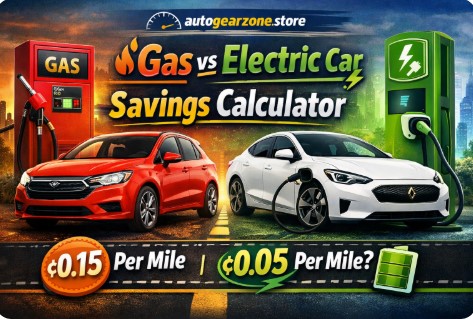
Gas vehicles are relatively straightforward to calculate. Divide the price of fuel by how many miles you can drive on it. If gas costs $4 per gallon and your car gets 25 mpg, your cost per mile sits around 16 cents. This changes quickly with traffic patterns, driving style, and maintenance issues like worn spark plugs, dirty air filters, or low tire pressure.
But there’s more beneath the surface. Gas cars carry indirect costs that don’t show up at the pump. Oil changes every 3,000-5,000 miles, transmission servicing, timing belt replacements, exhaust system repairs, and general engine wear all add up over time. While you don’t pay these costs per mile directly, they absolutely affect your true cost of ownership.
Real-World Example: A typical midsize sedan averaging 30 mpg with gas at $3.80 per gallon costs about 12.7 cents per mile in fuel alone. Add $800 annually in maintenance (oil changes, filters, inspections, occasional repairs), and you’re adding another 4 cents per mile for a driver covering 20,000 miles yearly. Total: roughly 16.7 cents per mile.
Cost Per Mile for Electric Cars
Electric cars use electricity instead of gasoline, measured in kilowatt-hours (kWh). A cost per mile electric car calculator divides your electricity rate by how many miles your car travels per kWh. If electricity costs 15 cents per kWh and your EV drives 4 miles per kWh, your cost per mile drops to under 4 cents.
Charging losses and extreme weather can raise this slightly. In cold climates, efficiency can drop to 2.5-3 miles per kWh during winter months. Even accounting for this, EVs typically cost significantly less per mile than gas vehicles. This is where most EV savings accumulate over the life of the vehicle.
Real-World Example: A modern long-range electric sedan achieves about 4.1 miles per kWh in typical conditions. At 13 cents per kWh (residential rate), that’s 3.2 cents per mile. Even with 15% charging loss factored in, you’re at 3.7 cents per mile. Add minimal maintenance (tire rotations, cabin air filters, brake fluid changes), and total cost might reach 5 cents per mile.
The Hidden Variables
Several factors affect these calculations:
For Gas Cars:
- Ethanol content in fuel (E10 vs E15 affects efficiency).
- Octane requirements (premium vs regular).
- Regional fuel taxes and seasonal pricing.
- Engine age and maintenance condition.
- Short trip vs highway driving patterns.
For Electric Cars:
- Public vs home charging rates (public DC fast charging can cost 3-4x more).
- Battery preconditioning needs in extreme weather.
- Charging speed preferences (slow charging is more efficient).
- Grid demand charges for commercial charging.
- Battery degradation over time (1-3% per year typically).
Cost Comparison Table: Gas vs Electric vs Hybrid vs PHEV
| Vehicle Type | Energy Cost per Mile | Maintenance Cost per Mile | Long-Term Cost Trend | Best Use Case |
|---|---|---|---|---|
| Gas Car | $0.12-$0.20 | $0.04-$0.08 | Rising with fuel prices | Long-distance highway driving |
| Electric Car | $0.03-$0.06 | $0.01-$0.02 | Stable, decreasing | Daily commutes with home charging |
| Hybrid | $0.08-$0.14 | $0.03-$0.05 | Moderate increases | Mixed city/highway without charging access |
| PHEV | $0.04-$0.15 | $0.02-$0.05 | Variable based on charging frequency | Short daily commutes with occasional long trips |
This table illustrates why calculators matter so much. A plug-in hybrid might cost less than a gas car if you charge it regularly, but it could cost more than a conventional hybrid if you rarely plug in. The difference between best and worst case can be $100+ monthly.
Understanding EV kWh Calculator and Electricity Costs
An EV kWh calculator focuses on how efficiently an electric vehicle converts stored energy into forward motion. Efficiency appears as either miles per kWh or kWh per 100 miles. Lower energy consumption means lower operating costs, obviously.
Most modern EVs fall between 2.5 and 4.5 miles per kWh, depending on size, weight, aerodynamics, and drivetrain design. Smaller, more aerodynamic vehicles can exceed 4.5 miles per kWh, while larger SUVs might achieve 2.2 miles per kWh.

Electricity Pricing: The Variable Everyone Underestimates
Electricity pricing gets overlooked constantly, but it matters enormously. Home charging typically costs less than public fast charging. The difference can be dramatic: home charging at 12 cents per kWh versus DC fast charging at 40-60 cents per kWh.
Time-of-use (TOU) plans available from many utilities can reduce costs further if you charge during off-peak hours, typically between 9 PM and 7 AM. These plans might offer electricity at 8-10 cents per kWh overnight versus 25-30 cents during peak afternoon hours.
Money-Saving Strategy: If your utility offers TOU rates, charging overnight can cut EV costs by 30-50% without changing your driving habits. This single change can save $400-800 annually for drivers covering 15,000 miles.
Regional Electricity Cost Variations
Electricity costs vary wildly across regions:
- Pacific Northwest: Often 8-10 cents per kWh (hydroelectric power)
- California: 20-35 cents per kWh (highest in continental US)
- Texas: 10-14 cents per kWh (deregulated market)
- Northeast: 18-25 cents per kWh (aging infrastructure)
- Midwest: 11-15 cents per kWh (coal and wind mix)
An electric SUV costs about $500 yearly to charge in Seattle but $1,400 in San Francisco, driving the same 12,000 miles. This 180% difference makes regional calculators essential for accurate comparisons.
EV Savings Beyond Fuel Alone
Fuel costs tell only part of the ownership story. EVs avoid oil changes, exhaust system repairs, transmission servicing, and many engine-related failures. Brake wear drops significantly due to regenerative braking, which captures energy during deceleration and returns it to the battery.
Over five to seven years of typical ownership, these avoided maintenance costs can total $3,000-6,000 compared to a comparable gas vehicle. That’s real money saved, not theoretical.
Maintenance Cost Breakdown: 5-Year Comparison
Gas Car (Midsize Sedan):
- Oil changes: $400-600
- Transmission service: $200-400
- Spark plugs/ignition: $200-400
- Air filters (engine/cabin): $150-250
- Exhaust repairs: $200-800
- Coolant flushes: $150-250
- Brake pads/rotors: $400-800
- Total: $1,700-3,500
Electric Car:
- Tire rotations: $150-300
- Cabin air filters: $80-150
- Brake fluid changes: $100-200
- Coolant (battery/motor): $100-200
- Brake pads/rotors: $150-300 (last much longer)
- Total: $580-1,150
Difference: $1,120-2,350 saved over 5 years, roughly $225-470 annually.
The Other Side: EV-Specific Costs
Fair comparison requires acknowledging EV-specific expenses:
- Home charger installation: $500-2,000 (one-time)
- Increased home insurance: $50-150 annually (not always)
- Tire replacement: Potentially 10-20% more frequent due to vehicle weight and instant torque
- Battery replacement: Rare within first 10 years, but costs $5,000-15,000 if needed after warranty expires
Despite these considerations, total cost of ownership calculations typically favor EVs for most drivers when factoring in current gas prices, electricity rates, and available incentives.
EV Savings Calculator Europe vs North America
An EV savings calculator Europe often shows different results compared to North America due to fundamental market differences. Fuel taxes run much higher in most European countries, making gas cars considerably more expensive to operate. While electricity prices may also exceed North American rates, EVs still tend to show stronger advantages.
European Market Differences
Higher fuel costs: Gasoline often costs $6-8 per gallon equivalent in Europe versus $3-4 in the US, widening the gap between gas and electric operating costs.
Shorter average trips: European drivers typically cover less annual mileage (7,000-9,000 miles) compared to Americans (12,000-15,000 miles), favoring the strengths of electric vehicles.
Better charging infrastructure: Many European cities offer extensive public charging networks, reducing range anxiety and making EVs more practical for apartment dwellers.
Stronger incentives: Various European countries provide purchase incentives, tax breaks, and access to bus lanes or city centers for EV owners.
North American Considerations
Lower gas prices: Cheaper fuel narrows the operating cost gap in some US states and Canadian provinces.
Longer average trips: Americans often drive farther daily, making range and charging speed more critical factors.
Suburban/rural charging gaps: Outside major cities, charging infrastructure remains patchy in many areas.
Variable incentives: Federal tax credits exist, but state and provincial incentives vary dramatically.
Regional Example: In countries with high EV adoption, a compact electric SUV costs about $800 yearly to charge and operate versus $3,200 for an equivalent gas SUV. In regions with lower electricity costs, the same comparison might show $600 for the EV versus $1,800 for gas. Both favor EVs, but the advantage varies by location.
Electric SUV vs Gas SUV Savings Example
Using a savings calculator to compare a popular electric SUV to a comparable gas-powered SUV provides concrete, real-world insight. Let’s examine a midsize electric SUV against a similar gas-powered model averaging 24 mpg combined.
The Math
Electric SUV (Long Range Model):
- Efficiency: 3.5 miles per kWh (real-world average).
- Electricity cost: $0.14 per kWh (national average).
- Cost per mile: $0.04
- Annual cost (12,000 miles): $480
- Maintenance: ~$200 annually.
Total Annual Operating Cost: $680
Gas-Powered SUV:
- Fuel economy: 24 mpg combined
- Gas price: $3.60 per gallon (national average)
- Cost per mile: $0.15
- Annual cost (12,000 miles): $1,800
- Maintenance: ~$700 annually
Total Annual Operating Cost: $2,500
Annual Savings: $1,820 Five-Year Savings: $9,100
Even accounting for the electric SUV’s higher purchase price (typically $8,000-12,000 more), the operating cost savings close that gap within 5-7 years for typical drivers. After that, every year represents pure savings.
Variables That Change the Calculation
This comparison shifts based on:
- Your local electricity and gas prices.
- Actual driving distance (savings increase with more miles).
- Charging habits (public fast charging reduces savings).
- Available tax credits (currently $7,500 federal for qualifying new EVs).
- Home charging capability versus reliance on public infrastructure.
Critical Point: If you must rely heavily on public DC fast charging at $0.40-0.60 per kWh, your electric vehicle operating costs could double or triple, significantly reducing or eliminating the advantage over gas.
Gas Savings Calculator Hybrid Explained
A gas savings calculator hybrid helps drivers understand the benefits of partial electrification without requiring charging infrastructure. Hybrids use electric motors at low speeds and during acceleration, with gas engines providing power on highways and recharging the battery.
This approach reduces fuel consumption without requiring external charging, making hybrids ideal for city driving where stop-and-go traffic is common.
How Hybrids Save Money
Hybrids excel in conditions where gas cars perform worst:
- City driving with frequent stops.
- Traffic congestion.
- Short trips where engines don’t reach optimal temperature.
- Delivery or rideshare driving with constant acceleration/deceleration.
In these scenarios, hybrids can achieve 40-50 mpg while comparable gas vehicles struggle to reach 25-30 mpg. The 60-100% improvement in fuel economy translates directly to cost savings.
Real Numbers: Hybrid vs Gas
Midsize Hybrid Sedan:
- Combined MPG: 52
- Annual fuel cost (12,000 miles at $3.60/gal): $831
- Maintenance: Similar to gas version (~$600 annually)
Standard Midsize Sedan (4-cylinder):
- Combined MPG: 32
- Annual fuel cost (12,000 miles at $3.60/gal): $1,350
- Maintenance: ~$600 annually
Annual Savings: $519
While these savings are less dramatic than full EVs, hybrids require zero infrastructure changes and work for anyone who can fill a gas tank. For drivers without home charging access, this represents the most practical efficiency improvement available.
When Hybrids Make Most Sense
Hybrids work best for:
- City commuters with unpredictable parking situations.
- Apartment or condo dwellers without dedicated parking.
- Drivers in regions with limited EV charging infrastructure.
- People taking frequent long trips beyond EV range.
- Budget-conscious buyers wanting efficiency without infrastructure investment.
PHEV Calculator and When Plug-In Hybrids Make Sense
A PHEV calculator becomes essential for plug-in hybrids because these vehicles can operate in two completely different modes. They can drive 20-50 miles on electricity alone, then switch to efficient hybrid operation for longer trips. Savings depend almost entirely on how often you charge.
The PHEV Sweet Spot
PHEVs deliver maximum value for drivers who:
- Commute under 40 miles daily round trip.
- Have reliable home or workplace charging.
- Take occasional road trips beyond EV range.
- Want EV efficiency without range anxiety.
For these drivers, a PHEV can operate like a full EV 80-90% of the time while eliminating the need to plan around charging stations for longer trips.
PHEV Cost Comparison
Let’s examine a popular compact PHEV SUV against both its gas equivalent and a full EV:
Scenario: 12,000 annual miles, 60% driven on electric, 40% on gas
Compact PHEV SUV:
- Electric miles (7,200): $252 at $0.14/kWh.
- Gas miles (4,800): $720 at 38 mpg, $3.60/gal.
- Total energy cost: $972
- Maintenance: ~$400 annually.
Gas-Only Version:
- All miles on gas: $1,620 at 30 mpg.
- Maintenance: ~$600 annually.
- Total: $2,220
Comparable Electric SUV:
- All miles electric: $480
- Maintenance: ~$200
- Total: $680
The PHEV falls between the two, offering significant savings versus gas while providing trip flexibility the EV can’t match. However, if you charge less frequently, costs approach the gas version.
The Charging Frequency Factor
This cannot be stressed enough: PHEV economics completely depend on actual charging behavior.
Charging daily:
- 70-80% electric operation typical.
- Approaches EV savings.
- Strong value proposition.
Charging 2-3 times weekly:
- 40-50% electric operation.
- Moderate savings.
- Value depends on gas prices.
Rarely charging:
- Functions as heavy, expensive hybrid.
- Poor value compared to standard hybrid.
- Defeats the purpose of PHEV ownership.
Honest Self-Assessment Required: Before buying a PHEV, honestly evaluate whether you’ll charge it regularly. If you won’t, you’re better off with a regular hybrid that costs less upfront and weighs less.
Choosing the Right Calculator for Your Driving Style
No single Gas vs Electric Car Savings Calculator fits every driver. Urban commuters, highway drivers, and occasional road-trippers all experience dramatically different costs. The best calculator asks for local fuel prices, electricity rates, realistic mileage estimates, and actual driving patterns.
What to Look for in a Calculator
Essential Features:
- Regional fuel and electricity price inputs.
- Vehicle-specific efficiency ratings (not just class averages).
- Maintenance cost estimates over time.
- Home charging vs public charging split.
- Available incentive calculations.
- Cold weather efficiency adjustments (if relevant).
Red Flags:
- Can’t customize electricity rates.
- Uses only highway or city MPG (not combined).
- Ignores charging infrastructure costs.
- Doesn’t account for battery degradation.
- Shows only best-case scenarios.
Multiple Scenario Testing
At autogearzone.store, we encourage drivers to test multiple scenarios rather than relying on single calculations. Try these variations:
Conservative Scenario:
- Higher fuel/electricity costs than current.
- Worse efficiency than rated (15% reduction).
- Include home charger installation.
- No incentives assumed.
Realistic Scenario:
- Current local prices.
- Manufacturer-rated efficiency.
- Typical maintenance costs.
- Available incentives included.
Optimistic Scenario:
- Lower energy costs (off-peak rates).
- Better than rated efficiency (gentle driving).
- Minimal maintenance needs.
- All available incentives.
If the conservative scenario still shows acceptable savings, you’re probably making a sound decision. If only the optimistic scenario works, think harder about the purchase.
Regional Factors That Change Everything
Your location dramatically affects gas versus electric economics. These regional variables can shift calculations by thousands of dollars annually:
Electricity Rates by Region
Low-cost electricity regions (8-12 cents/kWh):
- Pacific Northwest.
- Upper Midwest.
- Parts of Texas.
- EV advantage: Maximum.
Moderate electricity regions (13-18 cents/kWh):
- Southeast.
- Plains states.
- Mountain West.
- EV advantage: Strong.
High-cost electricity regions (20-35 cents/kWh):
- California.
- Hawaii.
- Parts of Northeast.
- EV advantage: Reduced but usually still present.
Climate Impact
Cold climates (regular below-freezing winters):
- EV range reduced 20-40% in winter
- Cabin heating draws significant power
- Battery charging slows
- Consider PHEV or hybrid instead for maximum flexibility
Moderate climates:
- Minimal seasonal efficiency variation.
- EVs perform close to rated specifications.
- Best environment for EV ownership.
Hot climates:
- Air conditioning reduces range 10-20%.
- Battery cooling systems engaged more frequently.
- Still more predictable than cold weather impact.
Infrastructure Availability
Urban/suburban with good charging:
- Multiple public charging options.
- Workplace charging possibly available.
- Home charging installation straightforward.
- EVs highly practical.
Rural or underserved areas:
- Limited public charging.
- Home charging essential.
- Range anxiety more significant.
- Consider PHEV for flexibility.
Tax Credits and Incentives: The Game Changers
Federal, state, and local incentives can dramatically shift the economics of EV ownership. These aren’t small numbers; they can total $10,000-15,000 in some jurisdictions.
Current Federal Incentives (2026)
New EV Tax Credit:
- Up to $7,500 for qualifying electric vehicles
- Income limits apply
- Vehicle must meet North American assembly requirements
- Battery component sourcing requirements
- Not all EVs qualify; check specific models
Used EV Tax Credit:
- Up to $4,000 for qualifying used EVs
- Vehicle must be at least 2 years old
- Price cap of $25,000
- Income limits apply
State and Local Incentives Examples
California:
- Additional $2,000-7,500 rebate (income-dependent)
- HOV lane access
- Potential utility rebates for charging equipment
Colorado:
- Up to $5,000 state credit
- Additional local utility incentives
New York:
- Up to $2,000 state rebate
- Local utility charging incentives
Texas:
- Light on statewide incentives
- Some local utility programs
- Lower electricity costs offset lack of purchase incentives
The True Cost Calculation
When comparing vehicle costs, always include available incentives in your initial price:
Example: Electric Sedan
- MSRP: $42,000
- Federal tax credit: -$7,500
- State incentive (example): -$2,000
- Effective price: $32,500
This brings the electric vehicle’s price into direct competition with comparable gas sedans, which suddenly makes the comparison much more favorable even before considering operating cost savings.
Common Mistakes People Make with Calculators
Even good calculators produce bad results when fed incorrect assumptions. Here are the most common errors:
Mistake #1: Using Manufacturer MPG/Efficiency Ratings
Manufacturers test under ideal laboratory conditions. Real-world efficiency typically runs 10-20% lower. Always reduce official ratings by at least 15% for realistic calculations.
Mistake #2: Ignoring Charging Losses
Home charging isn’t 100% efficient. You’ll lose 10-15% of electricity to heat during the charging process. Public fast charging can be even less efficient. Factor this into your cost calculations.
Mistake #3: Comparing Best-Case Scenarios
Don’t compare an EV’s efficiency in perfect weather with a gas car’s highway MPG. Use realistic, comparable conditions for both vehicles.
Mistake #4: Forgetting Maintenance Differences
EVs aren’t maintenance-free, but they require far less than gas cars. Ignoring this difference underestimates long-term EV savings by $1,000-2,000 annually.
Mistake #5: Not Factoring in Driving Style Changes
Many EV owners report driving more gently to maximize range, improving efficiency beyond rated numbers. Conversely, aggressive drivers may see worse efficiency than rated. Be honest about your driving style.
Mistake #6: Overlooking Depreciation Differences
EV resale values have been volatile. While improving, they historically depreciated faster than gas cars. Consider long-term ownership or leasing rather than 3-year ownership cycles.
Advanced Calculator Features Worth Having
As you get serious about comparing vehicles, these advanced features become valuable:
Total Cost of Ownership (TCO) Projections
Good calculators project 5, 7, or 10-year ownership costs including:
- Purchase price (minus incentives)
- Financing costs if applicable
- Energy costs
- Maintenance and repairs
- Insurance differences
- Projected resale value
This comprehensive view often reveals that a higher-priced EV costs less over time than a cheaper gas vehicle.
Break-Even Analysis
Shows when EV operating savings offset the higher purchase price. For many vehicles, this occurs within 4-6 years for typical drivers.
Sensitivity Analysis
Tests how results change when key variables shift:
- What if gas prices increase 20%?
- What if electricity rates rise?
- What if you drive 50% more/less than estimated?
Understanding these sensitivities helps make decisions that remain sound across different future scenarios.
Emissions Comparison
While not directly financial, many drivers care about environmental impact. Good calculators show CO2 emissions differences based on your regional electricity grid mix.
Building Your Personal Comparison Strategy
Here’s a practical approach to using calculators effectively:
Step 1: Gather Your Real Data
Before touching any calculator, collect:
- Last year’s actual driving mileage (check odometer or maintenance records)
- Your current monthly fuel expenses (check credit card statements)
- Local electricity rate (check recent utility bill)
- Current gas prices in your area
- Your daily commute distance
- Frequency of long trips beyond 200 miles
Step 2: Identify Realistic Vehicle Options
Pick 3-4 specific vehicle categories to compare, not just engine types:
- Current or comparable gas vehicle class
- 1-2 electric vehicle categories you’d consider
- Hybrid or PHEV alternative if relevant
Step 3: Run Conservative Calculations First
Use worst-case assumptions:
- 20% worse efficiency than rated
- Higher energy costs
- More frequent charging at public stations
- Full maintenance costs
- No incentives (unless guaranteed)
If this scenario works financially, you’re on solid ground.
Step 4: Test Realistic Scenarios
Now use current prices and manufacturer ratings. This shows your most likely experience.
Step 5: Consider Future Changes
Think about changes in your life that might affect the calculation:
- Moving to a different home (charging access?)
- Job change (commute distance?)
- Family changes (vehicle size needs?)
- Energy price trends in your region
Step 6: Make the Decision
If multiple scenarios show acceptable results and the vehicle meets your needs, you’ve found the right choice. If only best-case scenarios work, keep looking.
Real Owner Experiences: What the Numbers Miss
Calculators provide numerical clarity, but they miss subjective factors that affect satisfaction:
Positive Surprises EV Owners Report
- Home charging convenience: Starting every day with a “full tank” beats gas station stops
- Better driving experience: Instant torque and smooth, quiet operation
- Lower stress: No oil change reminders, no exhaust issues, fewer repair shop visits
- Cold weather benefits: Remote cabin preheating while plugged in
Negative Surprises EV Owners Report
- Range anxiety on road trips: Even with good infrastructure, planning required
- Winter range loss: More dramatic than expected in cold climates
- Public charging frustration: Broken chargers, wait times, higher costs
- Software dependency: Vehicle updates required, occasional bugs
What Hybrid Owners Value
- No behavior change required: Drive it like any car, fill it with gas
- Immediate efficiency gains: Better MPG from day one, no learning curve
- Reliability: Proven technology with long track record
- Universal servicing: Any mechanic can work on it
What PHEV Owners Wish They Knew
- Charging discipline required: Easy to fall into lazy habits and never plug in.
- Complexity: Two powertrains mean more potential issues.
- Weight penalty: Heavier than both gas and electric equivalents.
- Efficiency when not charging: Less efficient than regular hybrids when running on gas.
Common Questions Drivers Ask
Why do some EV owners save less than expected?
Several factors reduce real-world savings: frequent public fast charging at high rates, aggressive driving that reduces efficiency, living in areas with expensive electricity, cold climates reducing range, and not taking advantage of off-peak charging rates. Calculators typically assume optimal conditions, but personal habits and circumstances matter enormously.
Does fast charging erase EV savings?
Occasional fast charging doesn’t significantly impact economics. If you fast charge once or twice monthly, the higher cost is negligible. However, if you rely on public DC fast charging for most charging needs at $0.40-0.60 per kWh, your operating costs can approach or exceed gas vehicle costs, especially in regions with low gas prices.
Are hybrids still worth it in 2026?
Absolutely, especially for specific use cases. If you lack reliable charging access, make frequent long trips, drive primarily in city traffic, or want efficiency without infrastructure changes, hybrids remain an excellent choice. They deliver immediate efficiency improvements without requiring any lifestyle adaptation.
How accurate are online calculators?
They’re estimates, not guarantees. Accuracy depends entirely on input quality. Calculators using your actual local prices, realistic driving patterns, and honest efficiency expectations provide reasonably accurate projections. Those using national averages and ideal conditions can miss the mark by 30% or more.
Should I wait for better EV technology?
The “wait for next year” approach can delay ownership indefinitely. Current EVs meet most drivers’ needs today. However, if your specific use case doesn’t work with current technology (frequent 400+ mile days, extreme cold climate with no home charging), waiting might be sensible. For typical driving patterns, current EVs deliver proven value.
What about battery replacement costs?
Most EV batteries are warrantied for 8 years/100,000 miles minimum. Real-world data shows minimal failures within this period. Degradation averages 1-3% annually, meaning most batteries retain 80%+ capacity after 8-10 years. Replacement costs have dropped significantly (now $5,000-10,000 for many models) and continue declining. For most owners, battery replacement never becomes necessary during ownership.
FAQs
Are electric cars always cheaper per mile?
Not always, but usually. EVs cost less per mile when charged at home with reasonable electricity rates. However, heavy reliance on expensive public fast charging in regions with low gas prices can narrow or eliminate the advantage. Location and charging habits determine the actual savings.
How often should I recalculate my savings?
Recalculate annually or whenever major price changes occur. If gas prices jump $1 per gallon or electricity rates change significantly, rerun your numbers. Also recalculate if your driving patterns change substantially (new job, different commute, etc.).
Do EV savings change in winter?
Yes, significantly in cold climates. EVs can lose 20-40% of range in freezing temperatures due to battery chemistry, cabin heating, and reduced regenerative braking effectiveness. This reduces efficiency and increases cost per mile during winter months. Plan for seasonal variation in your calculations.
Is a Gas vs Electric Car savings Calculator useful for used cars?
Absolutely. Running costs apply regardless of vehicle age. In fact, calculators become more important for used EVs since you won’t receive tax credits but will still enjoy reduced operating costs. Make sure to factor in older battery degradation (typically 2-3% per year) when calculating used EV efficiency.
Can I trust manufacturer efficiency claims?
Not completely. EPA ratings for both gas and electric vehicles represent controlled testing. Real-world results typically run 10-20% lower. Always reduce official ratings in your calculations for realistic projections. Consumer reports, owner forums, and real-world testing provide more accurate efficiency data.
What if I can’t charge at home?
Without home charging, EV economics become less compelling. You’ll rely on public charging at higher rates, reducing savings significantly. Consider hybrids or PHEVs if you can’t install a home charger. Alternatively, investigate workplace charging options, which many employers offer free or at reduced rates.
Building Trust Through Real Comparisons
The goal at autogearzone.store isn’t selling you on any particular vehicle type. It’s providing clarity so you can make informed decisions. We rely on real-world data, actual owner experiences, and transparent assumptions rather than manufacturer marketing claims.
No calculator replaces personal judgment and individual circumstances. But informed comparisons reduce regret and buyer’s remorse. Whether you choose gas, electric, hybrid, or PHEV, understanding your true cost per mile and total ownership expenses puts you in control of the decision.
The right vehicle for your neighbor might be wrong for you. Climate, driving patterns, charging access, local energy prices, and personal preferences all matter. Use calculators as tools for clarity, not as decision-makers.
Final Thoughts
A Gas vs Electric Car Savings Calculator isn’t about proving one vehicle type is universally superior. It’s about understanding trade-offs based on your specific situation. Electric cars often excel in daily efficiency and long-term operating costs. Gas cars still offer simplicity and flexibility for long-distance drivers or those without charging access. Hybrids and PHEVs fill important gaps between the extremes.
The key is comparing vehicles using real inputs from your actual life, not idealized manufacturer assumptions. Focus on how you genuinely drive, where you actually live, and what energy costs you truly pay today. Factor in available incentives that you’ll definitely receive. Be honest about whether you’ll actually charge that PHEV every night or if you’ll get lazy after a few months.
This approach leads to smarter ownership decisions and fewer surprises years down the road. When you know your real cost per mile, you can make confident choices that align with both your budget and your needs.
The automotive landscape is changing rapidly. But the fundamental question remains the same: what will this vehicle actually cost you to own and operate? Get that answer right, and you’ll be satisfied with your decision regardless of which powertrain you choose.